 |
|
|
|
|
||||||||||
|
|
|
||||||||||
|
Technical
Tips from Mark W. Persons |
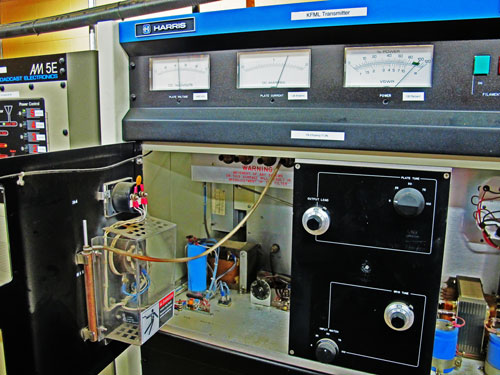
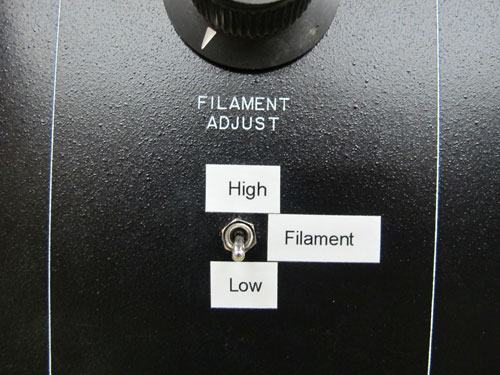
The reason why you are seeing this is the filament control only gives 0.3 volts of adjustment downward from the rated 5.0 volts. That is just a 6% control range. To get the best possible life out of a tube, the filament should be adjusted down by more than that after the first 200 hours of operation. |
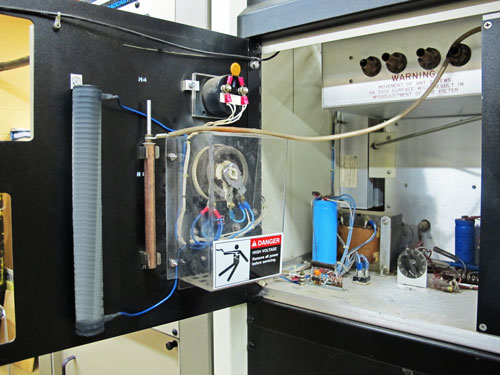
In this case, the filament voltage control was 10 ohms, although I found that some of these transmitters use a 7.5 ohm control. I installed a resistor, which was on hand at the station. It was 8 ohms at 200 watts. The best way to do this is to find out which value of filament control resistor is in the transmitter and then use an equivalent value 200 watt fixed resistor in series. With an 8 ohm resistor, the filament voltage was brought down to 4.5 volts, which is 9 percent below the rated 5.0 volts. The voltage is adjusted down until a significant drop in tube emission is observed and then cranked up just a bit. It is the sweet spot where best tube life is achieved. |
Story from 08-24-2011. |
| A tip on tuning Harris HT3.5,
HT5 and HT10 Transmitters: If the PA tuning capacitor is at
minimum and you still haven't gotten to a peak in power, then move the
coarse tuning slider to the left. If PA tuning capacitor is at
maximum, then move the coarse tuning slider to the right. That
coarse tuning is to the right of the tube as viewed from the rear of the
transmitter. Also, do not adjust the Grid Tune and Input Match for maximum PA tube grid drive. Instead, tune for minimum VSWR to the IPA. To do this, set the Multimeter to OVLD Set. Then find rotary switch S4 on the controller printed circuit card, which is behind the Multimeter switch. Set it to the VSWR position. The Multimeter now reads IPA VSWR. |
|
The stories go on and on.
Stop in again sometime. I'll leave the soldering iron on for you.
|
|
Questions? Email Mark Persons: teki@mwpersons.com |